

AI in the Workplace: Why Employees “Smuggle” AI Into Work – and What That’s Really Telling Us
A recent BBC headline caught our eye: “Why employees smuggle AI into work.”
At first glance, it sounds dramatic. A bit rogue. Slightly rebellious.
But if you look beneath the surface, it tells a much more human – and much more useful – story.
People aren’t sneaking AI tools into their work because they’re reckless.
They’re doing it because they’re trying to do a better job, in systems that haven’t yet caught up with reality.
At Talisman, we see this pattern everywhere.
What’s Really Going On?
Across organisations of all shapes and sizes, we’re seeing three overlapping groups:
1. Business owners who feel behind
You know AI matters, but you’re unsure where it fits, what’s safe, or how to introduce it without risk, cost, or disruption.
2. Quiet experimenters
People using ChatGPT, Copilot, or other tools unofficially to draft emails, summarise documents, analyse data, or speed things up – often without telling anyone.
3. Accidental rule-breakers
Well-intentioned staff who don’t realise they’re crossing data, security, or governance boundaries because no one has explained the rules in plain English.
None of this is about bad intent.
It’s about misalignment.

The Real Risk Isn’t AI in the Workplace – It’s Silence
When organisations don’t talk openly about AI, three things happen:
People make assumptions
Good practice becomes inconsistent
Risk increases, not decreases
Banning AI outright rarely works.
Ignoring it definitely doesn’t.
AI doesn’t disappear just because it isn’t acknowledged. It goes underground.
And when that happens, leaders lose visibility, teams lose confidence, and organisations lose the chance to shape AI use in a way that’s safe, ethical, and genuinely valuable.

A Talisman View: This Is a Wayfinding Problem
At Talisman, we don’t start with tools.
We start with orientation.
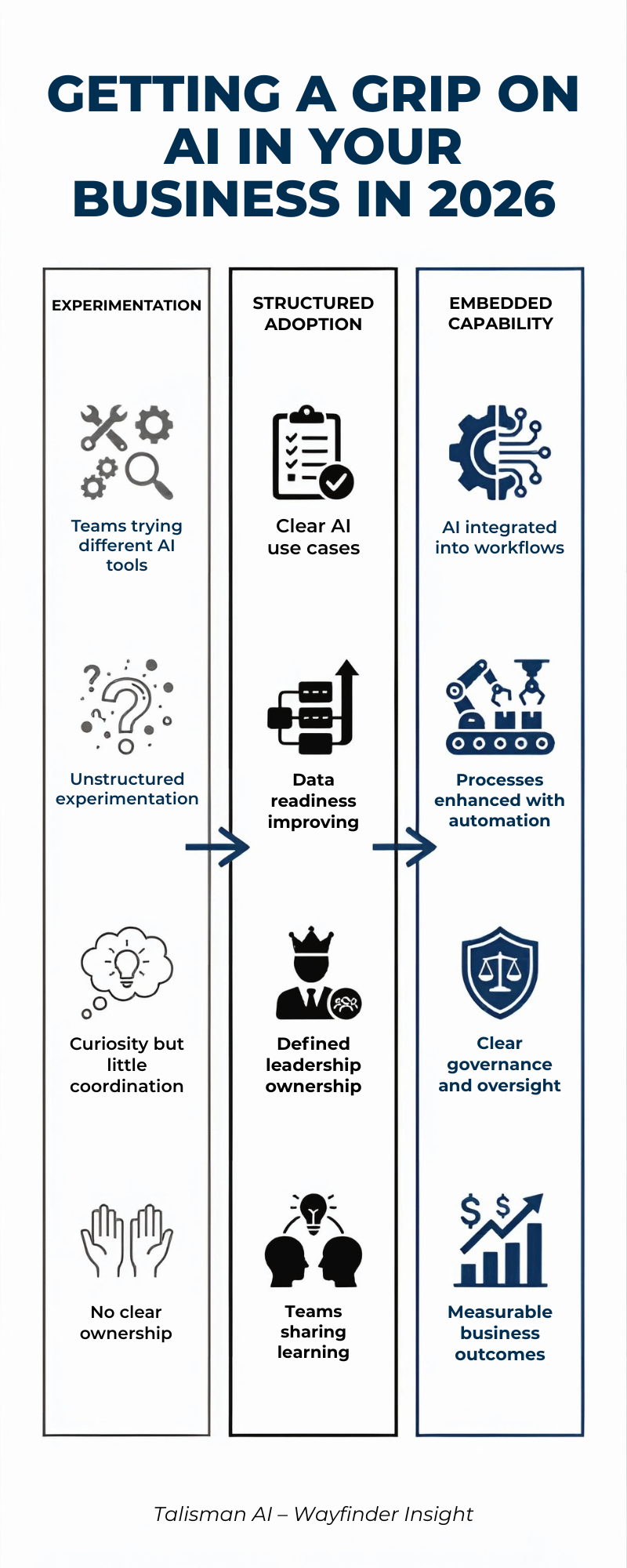
Most organisations don’t need an “AI strategy” as their first move for AI in the workplace.
They need clarity, permission, and a shared understanding of the path.
That means:
Giving people a safe space to ask questions
Being explicit about what’s allowed, what isn’t, and why
Helping teams understand where AI adds value – and where it doesn’t
Treating AI as a capability to be learned and guided, not smuggled or feared
When people feel supported, they stop hiding.
For Business Owners: What This Is Telling You
If AI is being used unofficially in your organisation, that’s not a failure.
It’s a signal.
It tells you:
Your people are proactive
Your systems may be lagging
Your guidance probably isn’t clear enough yet
The opportunity isn’t to clamp down – it’s to step in calmly and lead.
That starts with questions like:
Where are people already using AI?
What problems are they trying to solve?
What risks actually matter in our context?
How do we enable good use, safely?
For the “Smugglers”: You’re Not Alone
If you’re quietly using AI at work, you’re not unusual – you’re early.
But carrying the risk alone isn’t fair, and it isn’t sustainable.
You shouldn’t have to choose between:
being productive
and being compliant
The answer isn’t secrecy. It’s shared understanding.
The most effective organisations we work with create:
clear guardrails
open conversations
practical examples of good AI use
So experimentation becomes learning, not liability.
Calm Over Chaos. Clarity Over Hype.
AI adoption doesn’t need drama.
It needs:
calm leadership
clear principles
practical next steps
That’s the heart of the Talisman approach.
We help organisations find the right path with AI – one that’s safe, human-centred, and grounded in real work, not headlines.
If AI is already creeping into your organisation, the question isn’t “How do we stop it?”
It’s:
“How do we guide it well?”
That’s where real progress starts.

Comments