

Why Most Businesses Get AI Strategy Wrong
AI Leadership: Why Strategy Fails Without Clarity
Every few years, a technology wave arrives that promises to “change everything”.
AI is not that wave.
What AI is doing - quietly, relentlessly - is exposing how organisations actually work. Their decision-making. Their data discipline. Their leadership maturity. Their tolerance for ambiguity. Their ability to change.
And that’s why so many businesses feel uncomfortable with it - not because AI is too advanced...
...but because it shines a very bright light on what’s already there.
The Myth: “We Need an AI Strategy”
Let’s start by dismantling a popular misconception.
Most organisations don’t need an AI strategy for their business.
They need a clarity strategy.
I see businesses tying themselves in knots trying to answer questions like:
Which AI tools should we be using?
Should we be building or buying?
How do we avoid being left behind?
Those are second-order questions.
The first-order questions are much simpler — and much harder:
What decisions matter most in our business?
Where are people compensating for broken processes with effort?
Where do we rely on “heroics” rather than systems?
What information do we repeatedly wish we had, but don’t trust?
AI doesn’t magically fix those things.
But it will amplify them — for better or worse.

AI Adoption Strategy: Preparedness Beats Experimentation
The most dangerous organisations right now are not the cautious ones.
They’re the ones rushing ahead with:
tool-first adoption
isolated pilots
“innovation theatre”
AI initiatives that sit outside normal governance
These approaches feel progressive. They generate demos. They impress boards.
But they don’t scale — because they’re not anchored in how the organisation actually works.
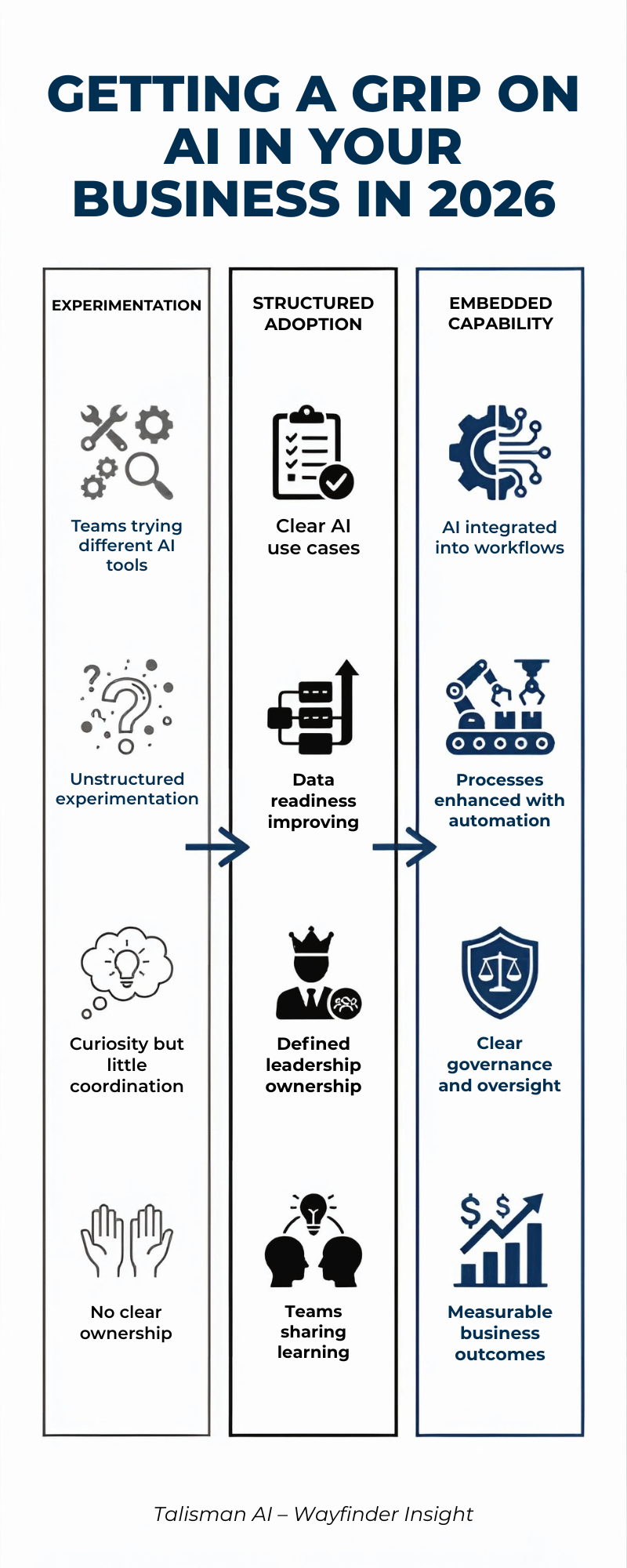
The organisations that will win with AI over the next 2–3 years are doing something far less glamorous:
stabilising their data foundations
getting honest about decision bottlenecks
building shared understanding across leadership
agreeing what good looks like before automating anything
That isn’t slow.
It’s deliberate.
AI Is a Management Challenge Wearing a Technical Costume
The uncomfortable truth many leaders eventually arrive at:
The hardest part of AI adoption has almost nothing to do with AI.
It’s about:
who owns decisions when machines are involved
how risk is understood, not avoided
whether leaders can tolerate probabilistic answers instead of certainty
how trust is built when outcomes are no longer fully explainable
These are human and organisational challenges — not software problems.
Which is why many technically sound AI initiatives stall:
teams don’t trust the outputs
leaders override them instinctively
nobody agrees who is accountable
adoption quietly fades
Not because the tech failed — but because the organisation wasn’t ready.
The Competitive Gap Is Quiet — Until It Isn’t
One of the biggest mistakes businesses make is waiting for a clear “AI moment”.
A visible tipping point.
A dramatic before-and-after.
That’s not how this plays out.
The real advantage of AI accumulates quietly:
faster internal decisions
fewer handoffs
better prioritisation
reduced cognitive load on skilled people
compounding marginal gains
By the time it’s obvious from the outside, the gap is already structural.
And it’s very hard to catch up to.
What Thoughtful Leaders Are Doing
Now
The most credible AI leaders I work with aren’t asking “How fast can we move?”
They’re asking:
Where would AI create genuine leverage in our business?
What would we stop doing if this worked?
What needs to be true — culturally and operationally — before we automate this?
How do we build confidence without dependency?
They’re treating AI as a capability to be grown, not a product to be installed.
That mindset difference matters.
A More Useful Way to Think About AI
If there’s one reframing I’d encourage, it’s this:
AI is not about replacing people.
It’s about removing friction from thinking, deciding, and acting.
Used well, it:
gives people back time for judgement
surfaces patterns humans miss
supports better conversations
reduces noise rather than adding to it
Used badly, it:
accelerates confusion
amplifies poor decisions
creates false confidence
erodes trust
The difference is rarely technical.
It’s organisational.
Final Thought
AI doesn’t demand that every business become a tech company.
But it does demand that leaders become more honest about how their organisations really function.
That’s the real challenge — and the real opportunity.
Those who approach AI with clarity, humility, and intent will build durable advantage.
Those who chase tools without understanding themselves will stay busy — but not better.
Comments