

The Great AI Delusion: Why Businesses Are Spending Billions to Fall Behind - AI Strategy in 2026
Global AI investment hit $242 billion in just the first quarter of 2026. Yet 79% of businesses are struggling to make AI work, and 95% of generative AI pilots are quietly dying on the vine. Something is badly wrong — and most leaders are too distracted by the hype to see it.
The Numbers Don't Add Up — And That's the Point
Let's start with the paradox that nobody in the boardroom wants to talk about.
In Q1 2026, the world poured $242 billion into AI; a figure that dwarfs the $59.6 billion invested in the same period just twelve months ago.
Microsoft, Google, Amazon and Meta are collectively spending hundreds of billions on data centres, chips and models. Anthropic's latest model is reportedly so capable at finding software vulnerabilities that they've decided not to release it publicly. The pace of progress is genuinely staggering.
And yet - 79% of organisations report facing significant challenges in actually adopting AI. A double-digit increase from 2025. A sobering MIT study found that 95% of generative AI pilots are failing to move beyond the proof-of-concept stage. Only 29% of businesses report meaningful ROI from their generative AI investments. And perhaps most telling of all: 54% of C-suite executives now admit that AI adoption is tearing their company apart internally.
More money. More models. More chaos. This is the Great AI Delusion — and it is playing out in real time across almost every industry and business regardless of size and budget.
The problem is not the technology. The technology has never been more powerful. The problem is the strategy — or rather, the wholesale absence of one.
The Real Story: We've Moved from Chatbots to Autonomous Agents - AI Strategy in 2026
To understand why the strategy gap is so dangerous right now, you need to understand what AI has actually become in 2026. We are no longer talking about chatbots that write emails or tools that summarise documents. Those are table stakes.
The frontier has shifted entirely to agentic AI; systems that don't just respond to prompts, but autonomously plan, execute, and complete complex multi-step tasks with minimal human oversight. Gartner projects that 40% of enterprise applications will embed task-specific AI agents by end of 2026, up from less than 5% in 2025. That is not an incremental change. That is a fundamental rewiring of how work gets done.
Microsoft has launched Copilot Cowork, an agentic tool that automates tasks across entire application ecosystems.
Anthropic is experimenting with an always-on AI agent designed to complete tasks entirely autonomously. Salesforce has transformed its Slackbot into a full autonomous work assistant. And Anthropic's Model Context Protocol — the infrastructure layer that lets AI agents communicate with any external tool or data source — crossed 97 million installs in March 2026 alone, with every major AI provider now shipping compatible tooling.
Think about what that means. Within 12 months, a significant portion of your enterprise software will have an autonomous AI agent embedded inside it. Not a feature. An agent. Something that can be delegated tasks and will go away and complete them.
We are not building a better autopilot. We are building a digital workforce. And most businesses have no idea how to manage it.
The organisations that get this (and act on it now) will have an insurmountable advantage. Their competitors will still be running workshops about prompt engineering.
The Productivity Trap: Why Individual Wins Don't Become Organisational Outcomes
Here is the most insidious dynamic in AI adoption today, and the one I see most frequently when working with businesses: the productivity-to-ROI disconnect.
AI super-users — the early adopters inside your organisation who have genuinely mastered these tools — are delivering up to 5x productivity gains. That's not marketing copy. That's documented. Your best people are getting dramatically more done.
So why are only 29% of organisations seeing significant ROI?
Because individual productivity and organisational performance are not the same thing. An AI system that makes one person 5x more productive doesn't automatically make a team 5x more effective.
It often makes the gaps in your processes more visible, not less. It exposes the fact that your data architecture was built for humans, not agents. It reveals that your workflows were designed around human bottlenecks that no longer exist — and that you have no idea what to do with the freed capacity.
The Deloitte State of AI report puts it plainly: the greatest hurdles to ROI are challenges involving people and processes, not technology.
IBM's analysis agrees: the AI skills gap is the biggest single barrier to integration — and critically, education alone is not the answer. The fundamental issue is that most organisations are treating AI as a tool to bolt on top of existing ways of working, rather than as a reason to rethink those ways of working from the ground up.
Giving everyone a power tool doesn't build a better house. You need an architect, a plan, and a construction team that knows how to use the tools together.
The Efficiency Revolution Nobody Is Talking About
While the AI strategy debate rages, a quieter revolution is making the competitive stakes even higher.
Researchers have just unveiled a new computational approach that reduces AI energy consumption by up to 100 times while actually improving accuracy. If this scales — and early indicators suggest it will — the cost barrier that has kept advanced AI exclusive to large enterprises is about to collapse.
Right now, running sophisticated AI agents at scale requires significant compute investment, which acts as a natural barrier to entry. That barrier is disappearing. Within 18 to 24 months, the same agentic AI capabilities available to a Fortune 500 company today will be accessible to a 10-person business at a fraction of the cost.
This is not good news if you are a large organisation using your AI budget as a moat. But it is extraordinary news for businesses that are building the strategic foundations now — because when the cost barrier falls, execution speed and organisational readiness will be the only competitive differentiators that matter.
What Winning Actually Looks Like in 2026
Ninety-three percent of senior leaders now believe that organisations that successfully scale AI agents in the next 12 months will achieve an insurmountable lead over their peers. That is a remarkable level of consensus. The question is what 'successfully scale' actually requires.
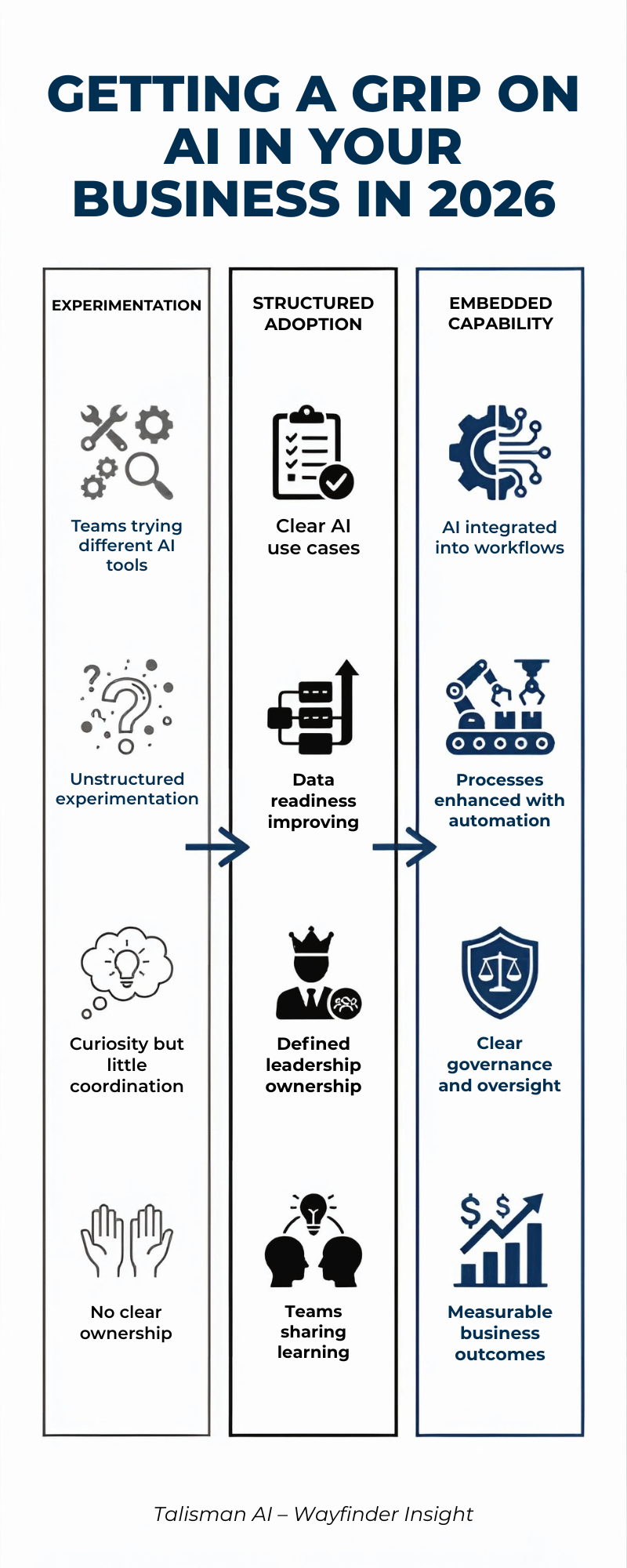
The evidence is increasingly clear. It is not about buying the most powerful model, or deploying the most tools, or running the most pilots. The organisations generating 5x to 10x ROI from AI agents share three things in common.
First, they started with strategy, not technology. They identified the specific workflows and business processes where AI would deliver outsized impact — and said no to everything else. Focused beats scattered, every time.
Second, they treated AI transformation as an organisational change programme, not an IT project. They invested in change management, restructured roles, and brought their workforce along on the journey. The technology was the easy part.
Third, they modernised their data architecture before deploying agents at scale. Current enterprise data infrastructure was built for ETL processes and data warehouses — it creates serious friction for AI agents that need to understand business context and make autonomous decisions. Fixing this is unglamorous work. It is also essential.
The businesses winning with AI right now are not the ones with the biggest budgets. They are the ones with the clearest thinking.
The Hard Truth: Most Businesses Need Help They Don't Know How to Ask For
Here is what I observe constantly in conversations with business leaders across sectors. They know AI is important. They are spending on it. They are running pilots. And they are quietly, privately terrified that they are doing it wrong — but unsure what 'right' looks like, and reluctant to admit the uncertainty.
The hype machine does not help. Every AI vendor promises transformation. Every conference promises clarity. And yet the data tells us that most organisations are investing heavily and seeing limited returns. Not because AI doesn't work (it absolutely does) but because deploying AI successfully requires a level of strategic, operational and organisational alignment that most businesses have simply never had to develop before.
This is the gap that matters. Not the model gap. Not the compute gap. The strategy and execution gap.
Businesses that close this gap in 2026 — by getting clear on where AI creates real value for them, by redesigning their processes and data foundations, and by building genuine AI capability inside their teams — will find themselves on the right side of what may be the most consequential business discontinuity of the last 30 years.
Those that don't will spend another year running pilots that go nowhere, watching their AI budget disappear, and wondering why the technology that works for everyone else isn't working for them.


Comments